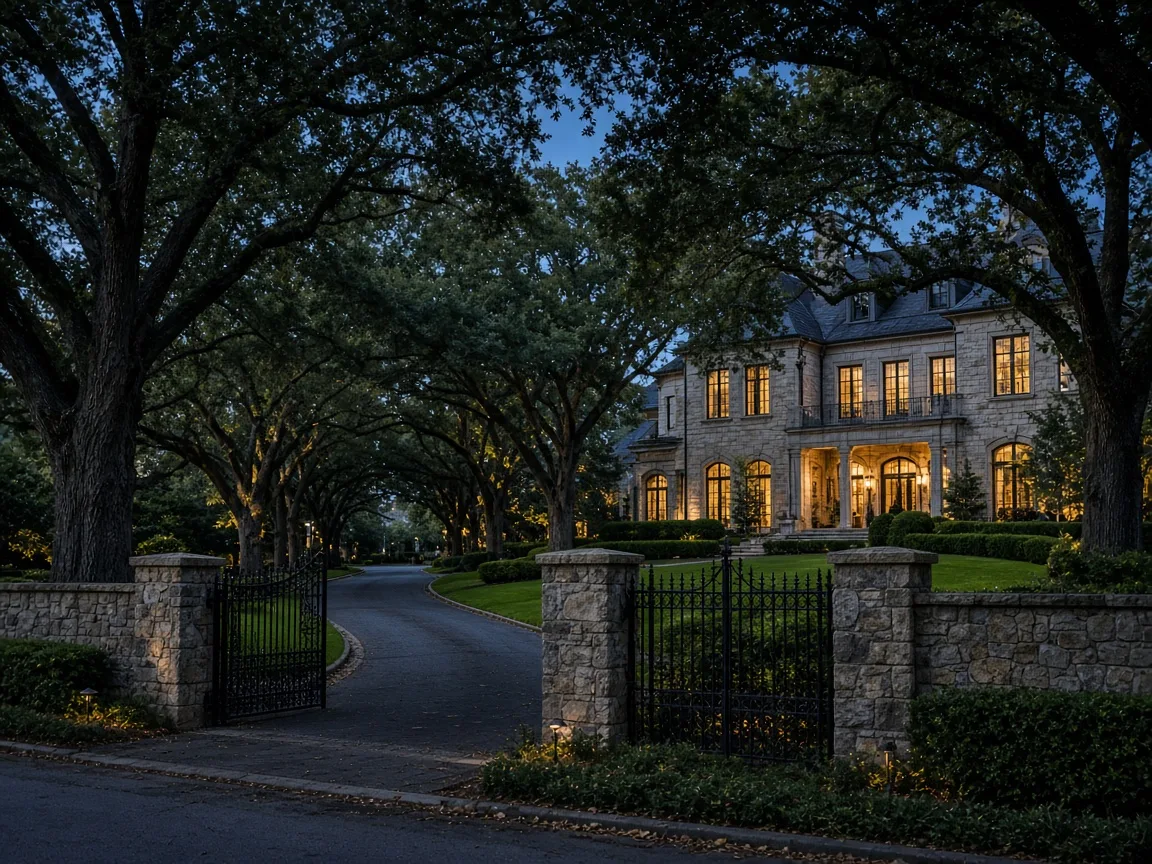
The honest answer is that off-market selling works for a small group of Dallas luxury sellers and quietly costs most of the rest. A pocket listing, an office exclusive, a private placement: by any name it is the same strategic choice, to sell a significant asset without offering it to the open market. The current Dallas data shows exactly where that trade-off sits in late 2026, and it divides sharply by ZIP code.
Here is what the evidence says about private sales, what the market is paying for exposure right now, and the few situations where going off-market is the smarter decision.
What Off-Market Selling Actually Means
Off-market selling means marketing a home privately, through one brokerage or a curated buyer list, rather than to the public through the MLS. It is a native practice at the luxury tier: estimates put the off-market share of luxury transactions between roughly 15 and 40 percent depending on market and price point, with the density highest at the very top, where some markets report that 30 to 40 percent of sales above $10 million never appear on the MLS (Nevada Real Estate Group; Estates MK). The National Association of REALTORS Clear Cooperation Policy, adopted in 2020, requires a marketed listing to be posted to the MLS within 24 hours, but its Office Exclusive carve-out still allows a brokerage to represent a seller privately without a public debut.
That carve-out is why pocket listings still exist at scale, and it is why the choice deserves analysis rather than romance. A private sale is not a secret better price; it is a deliberate reduction of the buyer pool. The strategic question is what that reduction costs you, in your ZIP code, in this market, and for whom it pays.
The Evidence on Price Is Genuinely Mixed
The most serious Dallas-region study of this question, a University of Georgia analysis of more than 700,000 Dallas-Fort Worth sales from 2002 through 2022, found pocket listings sold at an average premium of 1.7 percent over comparable MLS sales, and near 8 percent at the top one percent of the market (Hayunga, reported by HousingWire). That reads like an endorsement of private selling, and it is the number defenders of pocket listings quote. The important detail is the timing: the premium fell to roughly 0.9 percent and to statistical insignificance after Clear Cooperation took effect in 2020, and the study, one market and still under peer review, is actively debated (Inman, April 2026).
The broader evidence points the other way. In San Francisco, MLS-listed homes sold for approximately $302,000, about 18.6 percent, more than off-market homes over 2022 to 2024 (RealReports / San Francisco Association of REALTORS, reported by HousingWire). Zillow's analysis of more than 15 million transactions estimated that off-MLS listings cost sellers a combined $1.36 billion, and a 2025 North Carolina review put the off-market shortfall near $406 million across 16 counties, roughly $51,000 per transaction (RISMedia, July 2026; Yahoo Finance).
The synthesis is not complicated: privacy has a measurable price in most markets, and the one market where sellers historically earned a premium for it, Dallas, stopped demonstrating that premium after 2020. Private selling is not a path to a better price in the current data. It is an option for sellers who value something other than price enough to fund it.
What the Market Is Paying for Exposure Right Now
Dallas luxury market conditions in late 2026 make the exposure question concrete, ZIP code by ZIP code. Where supply is thin and market time is short, public exposure is the engine of price. Where supply runs above five months, the buyer pool is already limited, and a private channel narrows it further.
University Park. The strongest absorption story in the Park Cities: a median sale price of $2.845 million over January through August 2026, up 24.4 percent year over year, on 12 median days on market, with closed sales at 98.3 percent of original list price (The Agency Dallas, October 2026). At roughly 3.6 months of supply, this is a market where a correctly positioned home attracts its buyer in two weeks. Removing the competition generally removes the pricing pressure too.
Highland Park. The benchmark market holds near 2.9 to 3.2 months of supply with a median of about 30 days on market; 32 active listings stood against 103 closed sales over the prior 12 months, at a median near $2.91 million, up 12.2 percent year over year (Kistler Realty, October 2026; Updike Pugh / NTREIS, pulled November 10, 2026). Demand here outruns inventory, which is precisely the condition where broad exposure converts into multiple buyers working against one another.
Preston Hollow. The contrasting case: about 5.3 months of supply with 426 active listings (The Agency Dallas, October 2026), while the true luxury tier sits far above the area's headline median. New listings above the neighborhood's luxury line carried a median near $4.325 million, with an active median of $4.495 million (von Sues Group, November 2026), and median market time runs between 50 and 54 days (Realtor.com, September 2026). The buyer pool here is thinner across a wide price band. An off-market approach narrows a pool that does not need narrowing.
Frisco. The $1.5 million-and-above tier recorded 159 closings over the 12 months through October 30, 2026, at a $2.0 million median, 33 median days on market, and about 6.3 months of inventory with 83 active listings (Bailey Kemps Nelson, November 2026). With new construction competing directly for the same buyers, this is the market where maximum exposure matters most, and where a private placement concedes the widest ground.
When an Off-Market Approach Makes Sense
With the data as the baseline, there are genuine exceptions. Each requires that the seller's reason for privacy is real, the price is defensible, and the buyer situation is specific. In practice, off-market selling earns its place in five situations:
- Privacy is a genuine constraint, not a preference. Public figures, security-sensitive estates, and owners who do not want showings or valuations attached to their name have a real reason to limit exposure, and a measured price cost is rational when the alternative is a security or reputational risk.
- The property is genuinely one of one. Architecturally singular homes, significant estates, and assemblages with no true comparable pool have buyers who are a short, known list. Public marketing adds eyes, but the few buyers who can transact are likely already represented and known.
- A qualified buyer is already in hand. A neighbor, a family trust, a buyer's broker with a client waiting. If the transaction can be completed without marketing, the marketing was never the point, and a private negotiation can respect both sides.
- The home is not ready for a public debut. Tenant-occupied homes, estate properties, and homes in transition can be shown privately on a single set of terms rather than subjected to open-market visits.
- As a disciplined pre-market test. A fixed private window, typically 30 to 45 days, with pricing anchored to comparable evidence and a committed fallback plan to launch publicly if traction does not materialize. The discipline of the deadline is what makes this a strategy rather than drift.
When It Costs You
Every one of those cases has a mirror image. If no specific buyer is in hand, an off-market campaign is a bet that a smaller pool will produce the same result as a larger one, and the current Dallas data says that bet usually fails. There is no auction dynamic without competition, and no discovery mechanism that does not expose the property to every qualified buyer who could pay your number.
There is also a structure cost that sellers rarely price in: the double debut. A home that sits privately for two months and then appears publicly carries its accumulated market time into the open market, and the market reads a slow private start as a signal before the first public showing. The freshness that drives a luxury launch, the 12-day velocity University Park is delivering to well-priced homes, is a one-time asset, and a failed private window spends it.
A Few Questions to Ask Before You Decide
Rather than a blanket rule, the decision reduces to a short set of evidence-based questions:
- Is privacy a genuine, identifiable risk today, or a preference? The first can rationally bear a price cost. The second should not.
- Is a qualified buyer already in hand? If yes, and the price is supported by comparable evidence, the analysis is largely done. If you are hoping a buyer appears, you are betting on a narrower pool than your ZIP code already offers.
- What does your market reward? Under roughly four months of supply with sub-30-day market time, exposure is the engine of price. Above five months, your buyer pool is already small, and positioning, condition, and pricing accuracy matter more than the channel.
- What is the fallback? A private window is only a strategy with a deadline, an evidence-based price, and a committed public launch if it produces no traction.
What This Means for You
Off-market selling is not a workaround for pricing, and it is not a path to a bigger number in the current Dallas data. It is a positioning decision that should be made on evidence: the supply and absorption in your ZIP code, the size and readiness of the buyer pool, and the reason your situation justifies the measurable cost of privacy. For a small number of sellers, it is the right call. For most, the market that is paying 98.3 percent of list in 12 days in University Park is telling you what exposure is worth, and it is worth the full strategy behind it.
The numbers for your specific property are available: months of supply in your ZIP, absorption velocity, the comparable evidence, and what each path, public or private, implies for price, timing, and certainty. The question is whether your situation is the exception that justifies the trade, and that is a question the data can answer.
If you are weighing whether your situation is one of the exceptions where private placement makes sense, I would welcome the opportunity to walk through the ZIP-level data on your property: supply, absorption, the comparable evidence, and what each path implies for price and certainty. Clarity creates confidence, and the numbers are the place to start.
Data Referenced
- National Association of REALTORS, Clear Cooperation Policy, adopted 2020, and its Office Exclusive carve-out.
- Hayunga (University of Georgia), Dallas-Fort Worth pocket-listing pricing analysis, 700,000+ sales, 2002-2022, reported by HousingWire, 2026; critique by Inman, April 2026.
- RealReports / San Francisco Association of REALTORS, MLS vs off-market price analysis, 2022-2024 sales, reported by HousingWire.
- Zillow, off-MLS listing price impact analysis, 2023-2025, reported by RISMedia, July 2026.
- North Carolina off-market sales analysis, 2025, reported by Yahoo Finance.
- The Agency Dallas, Dallas Luxury Market Report, October 2026 (University Park and Preston Hollow data; NTREIS closed sales January through August 2026).
- Kistler Realty, Highland Park Market Intelligence Report, October 2026.
- Updike Pugh / NTREIS, 75229 Market Watch, data pulled November 10, 2026.
- von Sues Group, Preston Hollow Luxury Market Report, November 2026.
- Bailey Kemps Nelson Group, Frisco Market Report, November 2026 (data through October 30, 2026).
- Realtor.com, Preston Hollow Housing Market data, September 2026.
Figures are drawn from publicly available reporting as of November 2026 and are dated in each reference. Estimates of off-market transaction share vary by methodology and market. Market conditions change. Contact Jana Fariss for the most current data and a personalized analysis for your property.
Powered by Meridian Residential Intelligence™, our proprietary market analytics platform identifies market shifts, luxury opportunities, and emerging trends before they become obvious to the broader market. Helping clients make smarter decisions across Dallas and Oklahoma City.
Let's look at what the market is telling us about your home.
A strategy consultation includes a ZIP-level analysis of supply, the buyer pool in your market, and what the public and private paths each imply for price and timing for your specific property.
Schedule a Strategy Session