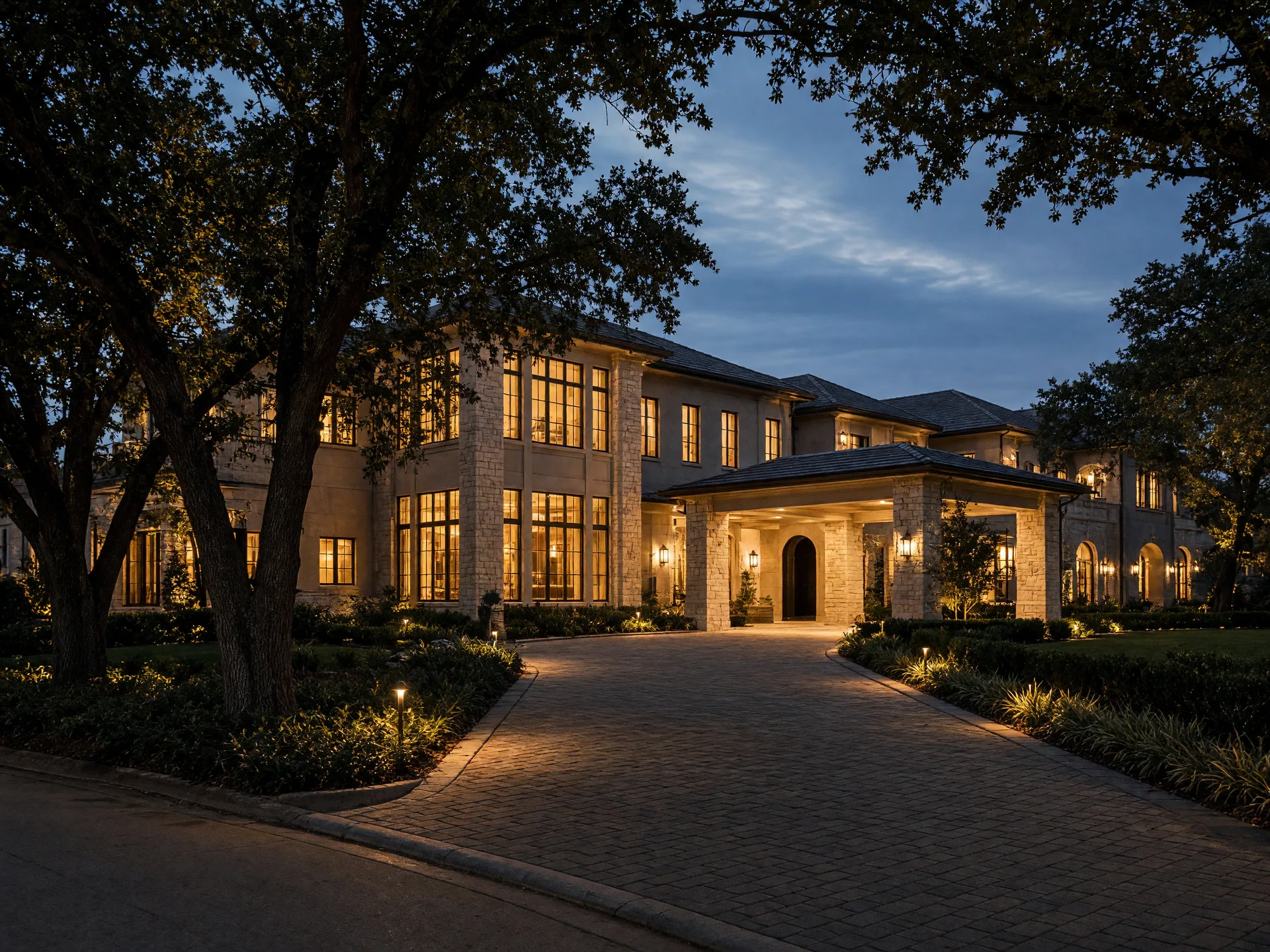
Selling a luxury home in Dallas costs more than a commission. The full stack includes listing and buyer-agent compensation, owner's title insurance, escrow and settlement fees, prorated property taxes, seller concessions, and, for some sellers, federal capital gains tax, and it typically lands between 6% and 8% of the sale price before you account for the cost of market time. The strategic question is not what the line items add up to, but what each one means for your net proceeds, and how the current market in your ZIP code shapes the ones you can actually influence.
Here is what the current evidence says about each cost, ZIP code by ZIP code, and how to model your sale so the numbers drive the decision rather than the other way around.
What the Current Data Says About Selling Costs Right Now
The Dallas luxury market is still setting records, but it has turned more deliberate. Texas Realtors reported a record 14,418 Texas homes sold above $1 million between November 2024 and October 2025, with Dallas-Fort Worth accounting for 38% of the state total, roughly 5,485 homes worth about $9.7 billion, at a median closing price near $1.42 million (Texas Realtors, 2026). Heading into fall 2026, the metro carries roughly 33,000 to 34,500 active listings and about 4.5 months of supply, a buyer-leaning balance, while the luxury tier keeps outperforming: $1 million-plus closed sales were up about 14% year over year in September 2026 at a flat median near $1.4 million, and luxury prices gained roughly 3.5% even as starter-home prices fell (RISMedia, October 2026; Redfin data).
That split shows up directly in seller costs. Redfin found concessions in 53.3% of Dallas sales in September 2026, up 6.5 points from a year earlier, and roughly a quarter of DFW listings have taken a price cut (RISMedia, October 2026). But luxury sellers concede less often and at a smaller share of price than the general market: on 2025 DFW data, about 31% of $1 million to $2.5 million deals included a concession at a median of roughly $6,800, about half a percent of price, while only about 17% of deals above $2.5 million did, at a median near $14,000 (Haistings Real Estate; Dunnican Team). The takeaway is not that luxury sellers escape costs. It is that their costs show up differently: less in closing credits, more in price positioning, rate buydowns, and market time.
The Line Items, One by One
Commissions. The largest line item. Total compensation in DFW averaged about 5.44% in 2026, typically split between the listing side and the buyer's agent, and since the August 2024 settlement, buyer-agent compensation is separately negotiated rather than automatically paid from the listing side (LRG Realty; Nitin Gupta DFW, 2026). On a $2.5 million home, a 5% total is $125,000, so the structure of that negotiation is real money. Commission is also the line item most tied to what you are buying: exposure, positioning, negotiation, and the analytics behind all three.
Owner's title insurance. In Texas the seller customarily pays for the buyer's owner's title policy. Rates are set by the Texas Department of Insurance, which cut basic premium rates 6.2% effective March 1, 2026 (Neuhaus Realty Group; LRG Realty, 2026). On a $500,000 to $600,000 sale the owner's policy typically runs $2,900 to $3,200, and it scales with price, so on a multi-million-dollar property it becomes a four-figure line item worth knowing before you see the closing statement.
Escrow and settlement fees. The seller's share of escrow, title, and settlement work typically runs $400 to $800, with some settlement packages higher depending on the transaction's complexity (Nine BP; Neuhaus Realty Group, 2026). Modest, but it belongs in the model.
Transfer taxes. Texas has no state, county, or city real estate transfer or documentary tax. That is a genuine structural advantage for sellers here, and it keeps the cost stack lower than in many comparable luxury markets (Neuhaus Realty Group; Herring Bank, 2026).
Prorated property taxes. Dallas-area effective property tax rates run roughly 2% or more, and the seller covers taxes through the closing date. On a $2 million sale that proration can be several thousand dollars depending on the month you close, so timing has a measurable effect on proceeds (Neuhaus Realty Group, 2026).
HOA and transfer fees. In communities with an HOA, the resale certificate and transfer fees typically run $200 to $500, and some communities require more (Neuhaus Realty Group, 2026). A small line item that matters mainly because it is easy to forget.
Concessions. The variable line item, and the one the market data shapes most. As noted, luxury tiers concede less often, but when they do, the typical forms are closing-cost credits, repair credits, or rate buydowns, and loan-type caps set the ceiling on how large a credit a financed buyer can accept (Dunnican Team, 2026).
Capital gains. For sellers with substantial gain, the federal exclusion under Section 121 is unchanged in 2026: up to $250,000 of gain is excluded for single filers and up to $500,000 for married couples filing jointly, provided the home was owned and used as a principal residence for two of the five years before the sale (26 U.S.C. § 121). The limits have not been adjusted since 1997, so in a market where luxury values have compounded for decades, gain above the exclusion is a real number for many sellers. Proposals to double the exclusion, including the More Homes on the Market Act, have not been enacted, so plan around the current law and confirm the math with your tax advisor (Arca Labs; America First Policy Institute, 2026).
The Most Expensive Line Item Is Market Time
The line items above are mostly fixed. The cost that moves is time. Every month a home sits unsold carries mortgage payments, insurance, taxes, maintenance, and the quiet erosion of buyer perception as days on market accumulate, and in the current Dallas market, overpricing is the fastest way to buy that cost.
Think of it in net-proceeds terms. A home priced to invite competition may close in three to four weeks with a modest concession or none at all. The same home priced 5% above its comparable-supported range can sit 90 days, absorb two price reductions, and ultimately close below the disciplined price, after carrying three months of expenses and negotiating from a weakened position. The concession that converts an offer is usually cheaper than the market time that follows a refused one, and the ZIP-level data tells you which dynamic you are in.
How the ZIP Codes Change the Math
The same cost stack produces different net proceeds depending on where the home sits, because market time, concession pressure, and buyer depth vary sharply across the Dallas luxury ZIPs. Here is what the current numbers suggest for each.
Highland Park. The benchmark Dallas luxury market, with median sale prices running roughly $2.7 million to $3.2 million depending on the reporting window and market time that has lengthened from about 44 days to the mid-50s over the past year (Briggs Freeman Sotheby's, February 2026; Dallas Luxury Realty, 2026; TX Roots Global, 2026). Supply remains among the tightest in North Texas, which supports offers close to list for well-presented homes and keeps concession pressure relatively light. With a higher price point, the fixed costs, title, escrow, and prorated taxes, are larger in dollars, which makes pricing precision worth more here than anywhere else.
University Park. A deeper and faster pool. University Park has cleared medians above $2.1 million, with recent monthly medians running near $2.9 million to $3.0 million and market time of roughly 23 to 35 days for well-priced homes (TX Roots Global, 2026). When offers arrive within three weeks, the cost of market time is minimal and the main variable is choosing among terms. This is a ZIP where a disciplined list price can nearly eliminate the concession line item.
Preston Hollow. The slowest segment of the comparable set. Market time stretched to about 61 days in April 2026, the longest among the Dallas luxury markets, with sale-to-list ratios near 95.5% in recent reporting (Compass, Natalie Hatchett, April 2026; The TX Collective Group, 2026). Carrying costs matter most here: every extra month of exposure is a direct hit to net proceeds, and price reductions have been common. For Preston Hollow sellers, the cost model should weigh a realistic initial price against the near-certain cost of a correction later.
Northwest Dallas. The median sits just under $900,000, up about 4.8% year over year, with roughly 48 days on market in recent reporting (Redfin, September 2026). The buyer pool is active, and the cost stack is smaller in absolute dollars. The fastest way to protect proceeds here is positioning that generates competition rather than negotiation.
Frisco. The luxury ZIP 75034 has run near 84 days on market at a median list around $1.0 million, with new construction competing for the same buyers and roughly 4.7 months of metro supply (TCFG Homes, spring 2026; TX Roots Global, October 2026). Expect more concession pressure and longer inspection and financing timelines. In Frisco, the model should build in both a concession line item and a longer carrying-cost window, because both are more likely than in the Park Cities.
Southlake. Southlake's months-of-supply ladder tells the story: about 3.5 months between $1 million and $1.5 million, 5.2 months between $1.5 million and $2.5 million, and 8.4 months above $2.5 million, with market time stretching from roughly 42 to 95 days across those tiers (USTech Automations, NTREIS data, 2026; BlueFuse Realty, 2026). Sale-to-list ratios run near 97% at $2 million to $2.5 million and ease to about 94% above $3.5 million, and cash made up 43% of luxury purchases in January 2026 (Nitin Gupta DFW, January 2026). The top tier demands the longest carrying-cost horizon in this set, and pricing discipline is the single largest lever on net proceeds.
Trophy Club. The median has climbed about 10.7% to 11% year over year to roughly $822,000 to $867,000, with market time near 29 to 47 days (Redfin, 2026; Grey Square, 2026). Buyers move quickly and offers tend to track list price closely. The cost stack is smallest here, and the main risk is under-pricing momentum rather than overpricing, which makes the analysis different from the premium metro ZIPs.
Building Your Net Proceeds Model
Reduce the decision to one number: projected net proceeds, meaning the gross sale price minus commission, title, escrow, prorated taxes, concessions, and any capital gains, measured against the probability of closing within your timeline. Then compare scenarios. A list price that converts in four weeks with a 0.5% concession often nets more than a list price that requires 90 days, two reductions, and a 2% concession to sell at all.
The data gives you the inputs: current sale-to-list ratios in your ZIP, market time for your price tier, the share of deals that include concessions and at what size, and the carrying cost of each additional month. That is the difference between guessing at a number and knowing the number. Real estate decisions should be driven by insight, not guesswork, and net proceeds is the insight that matters most to a seller.
What This Means for You
The cost of selling a luxury home in Dallas is a stack of line items, and most of them are either fixed by regulation or shaped by positioning. Texas's zero transfer tax and the 2026 title-rate reduction help at the margins. The costs you control are the ones the market data controls: list price, timing, concession strategy, and how many months of market time you are willing to fund. Model them together, and the decision stops feeling like a cost and starts reading like a strategy.
If you are considering a sale, I would welcome the chance to build your net proceeds model with you: every line item, your ZIP's current sale-to-list and market-time data, and the pricing and timing scenarios that protect the most value. Clarity creates confidence, and the numbers are the place to start.
Data Referenced
- Texas Realtors, "More Homes in Texas Sold for $1 Million+ Than Ever Before," 2026 (record 14,418 Texas $1M+ sales, November 2024 through October 2025; DFW 38% of state total, ~5,485 homes, ~$9.7B; median closing price ~$1.42M).
- RISMedia, "Price Cuts Reach September Record as Inventory Nears Pre-Pandemic Levels," October 7, 2026 (metro supply ~4.3 to 4.6 months; 53.3% of Dallas sales included concessions in September 2026, up 6.5 points YoY; ~quarter of DFW listings price-cut; $1M+ closed sales up ~14% YoY at flat ~$1.4M median).
- Redfin housing market data for Dallas, Highland Park, University Park, Preston Hollow, Northwest Dallas, Southlake, and Trophy Club, 2026.
- Haistings Real Estate, "The Hidden Cost of Selling: What Dallas Sellers Pay in Concessions," 2026, and Dunnican Team, "Seller Concessions in Texas," August 2026 (2025 DFW concession shares by price tier: 31% of $1M-$2.5M deals, median ~$6,800, ~0.5%; 17% of $2.5M+ deals, median ~$14,000, ~0.4%).
- LRG Realty, "Seller Closing Costs in Texas: 2026 Line-by-Line Breakdown," and Nitin Gupta DFW, "Seller Closing Costs in Texas: What DFW Home Sellers Actually Pay at Closing, 2026" (DFW average total commission ~5.44%; post-settlement buyer-agent compensation structure).
- Neuhaus Realty Group, "Seller Closing Costs in Texas: The Complete 2026 Guide" (owner's title policy ranges; TDI basic premium rate cut 6.2% effective March 1, 2026; escrow $400-$800; Texas transfer tax 0%; property tax proration; HOA transfer fees).
- 26 U.S.C. § 121 (home-sale gain exclusion: $250,000 single / $500,000 married filing jointly, two-of-five-years ownership and use test); Arca Labs, "Home Sale Capital Gains Exclusion 2026"; America First Policy Institute, "Modernizing the Home Sale Capital Gains Exclusion" (pending proposals not enacted).
- Briggs Freeman Sotheby's, luxury market commentary, February 2026; Dallas Luxury Realty, "Definitive 2026 Guide to High-End Real Estate in DFW"; TX Roots Global, Highland Park and University Park 2026 market reports.
- Compass (Natalie Hatchett), Dallas Luxury Market Report, April 2026; The TX Collective Group, Preston Hollow luxury market trends, 2026.
- TCFG Homes, Frisco luxury market updates, spring 2026; TX Roots Global, Frisco housing market report, October 2026.
- USTech Automations, "Southlake TX Housing Inventory & Growth Data 2026" (NTREIS-based months of supply and days on market by $1M+ tier); BlueFuse Realty, Southlake luxury real estate market report, 2026; Nitin Gupta DFW, Southlake luxury market update, January 2026 (43% cash buyers).
- Grey Square, "Trophy Club, Texas in 2026: Prices Up 11%," 2026.
- Local MLS compilations for Dallas luxury ZIPs, 2026.
Figures are drawn from publicly available reporting as of November 2026 and are dated in each reference. Sources cover different windows and property subsets, so figures can vary; contact Jana Fariss for the most current data and a personalized net proceeds model for your property.
Powered by Meridian Residential Intelligence™, our proprietary market analytics platform identifies market shifts, luxury opportunities, and emerging trends before they become obvious to the broader market. Helping clients make smarter decisions across Dallas and Oklahoma City.
Let's look at what the market is telling us about the cost of your sale.
A strategy consultation includes a ZIP-level net proceeds model built on supply, recent closed sales, market time, and concession data in your specific subarea, so you can decide with the full picture in front of you.
Schedule a Strategy Session