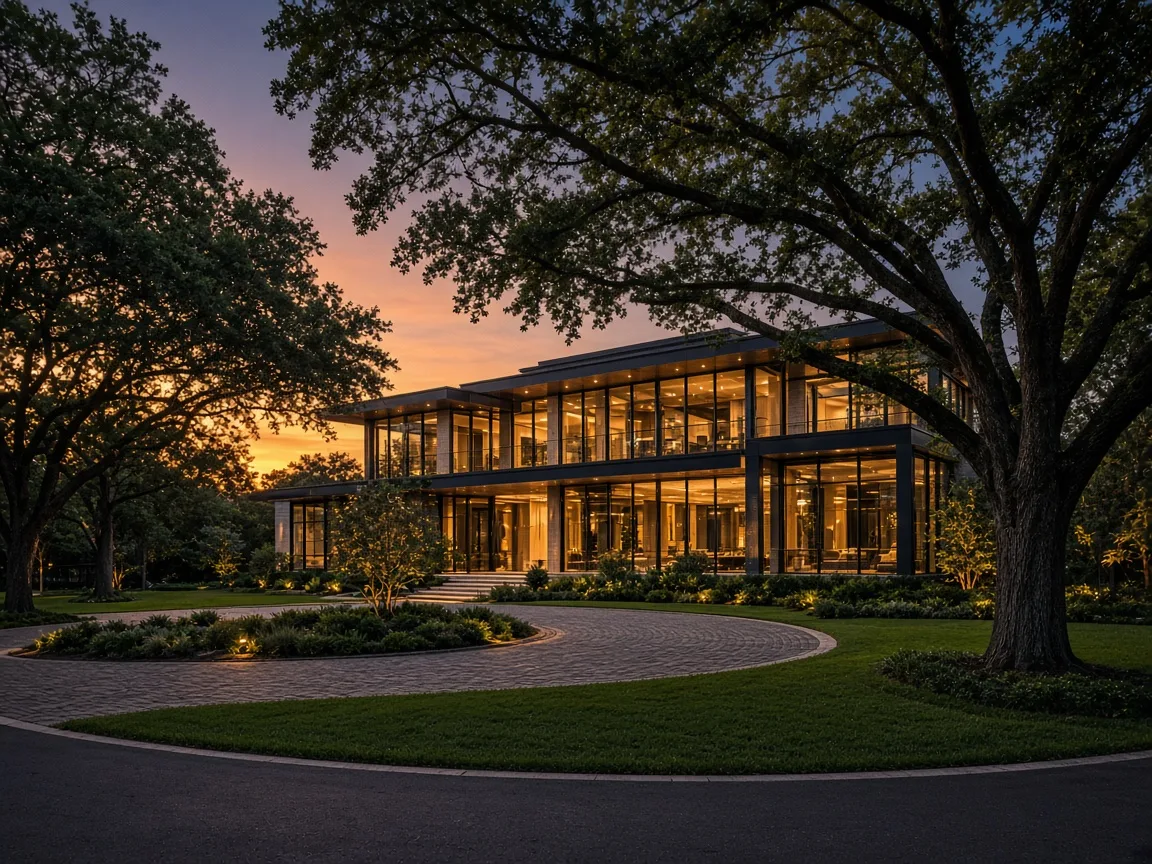
The short answer is that interest rates matter to the Dallas luxury market far less than the headlines suggest, and where they do matter is not where most sellers expect. The luxury tier is the most cash-heavy segment of housing: in DFW, roughly half of million-dollar-plus purchases have been all-cash in recent years, and brokers report the share still rising. Rates shape the market indirectly, through the financed move-up buyer and through sentiment, but for most luxury sellers the number that decides your outcome is not the rate. It is how accurately your home is priced and positioned against the buyer pool that actually exists in your ZIP code.
Here is what the current data says about how rates move through the Dallas luxury market, and what that means for your decision.
How Rates Actually Reach the Luxury Tier
The transmission channel from mortgage rates to home prices runs through the buyer who finances. Luxury buyers are disproportionately not that buyer. Nationally, the all-cash share of U.S. luxury purchases reached a record near 47 percent in early 2024 (Redfin), and luxury specialists report the share has kept climbing: nearly two-thirds said they saw more all-cash purchases in 2026, up from 51 percent a year earlier (Institute for Luxury Home Marketing, 2026 survey). The pattern in Dallas is even sharper. Of roughly 4,992 transactions in DFW's million-dollar-plus segment between November 2023 and October 2024, nearly half were all-cash (NAR analysis via The Real Deal), and area brokers put the share of cash luxury buyers near 40 percent in 2025.
The rate itself has risen through 2026: Dallas-area luxury mortgage rates held in the mid-6 percent range in early July, crossed 7 percent in late September, and by November sat near 7.3 percent for a 30-year fixed and about 7.45 percent for a jumbo (Freddie Mac; Bankrate). Yet through the third quarter of 2026, North Texas luxury largely did not feel the headwinds, even with a Federal Reserve rate increase and inflation concerns in the news (Briggs Freeman, October 2026). The reason is structural, not seasonal: a buyer paying cash prices the asset, not the monthly payment. For the majority of luxury buyers in Dallas, the 30-year rate is simply not the deciding variable.
The Financed Buyer Still Exists. Know Who They Are.
None of this means financing has disappeared from the luxury market. A meaningful share of Dallas luxury buyers are jumbo-financed: relocating executives, move-up families, and investors who choose leverage deliberately. That pool is rate-sensitive in a way the cash buyer is not, and it is the segment most squeezed at 7.3 percent. What matters for sellers is what that means in practice. Seller-paid rate buydowns and concessions, the tools that prop up demand in the broader market, fall increasingly flat above a certain luxury price point (KeyCrew, 2026), because the monthly swing a buydown buys is small relative to the price, and the financed buyer is comparing full packages, not payments alone.
The consequence is a market where the buyer who does finance is more deliberate, and where the home that wins is the one whose condition, presentation, and price answer the comparison on the table. In University Park, homes closed at a median of 12 days on market through August 2026, at roughly 98.3 percent of original list price, with mortgage rates already elevated (The Agency Dallas). Demand in the well-positioned luxury tier has not been rationed by rates; it has been concentrated on the listings that are decision-ready.
The ZIP-Level Read for Sellers Right Now
Citywide and countywide figures confirm that supply, not rates, is the variable to watch. Dallas County's luxury tier above $1.5 million recorded 1,074 closings over the trailing 12 months at a median sale price of $2.36 million, with a median 33 days on market and about 6.1 months of inventory (NTREIS through October 30, 2026, via Bailey Kemps Nelson). The ten-ZIP luxury trackers show a similar shape: a median list price near $968,000, 58 median days on market, and 3.1 months of inventory (Natalie Hatchett, September 2026). Inventory has normalized to a more balanced level, and that balance, not the rate, sets the pace.
Highland Park. The benchmark market remains thin-supplied at roughly 2.9 to 3 months, with a median sale price near $2.85 million and price per square foot up about 2.7 percent to roughly $807, even as the headline median eased with the mix of closings (The Agency Dallas, closed sales January through August 2026). Sellers here are not competing with rates; they are competing on condition against a short list of alternatives.
University Park. The strongest absorption story in the Park Cities. The median sale price rose about 24 percent year over year to $2.845 million, price per square foot climbed about 9.6 percent to $688, and 12 median days on market tells you what rate-immune demand looks like when positioning is right (The Agency Dallas).
Preston Hollow. The softest balance of the core Dallas ZIPs at roughly 5.3 months of supply with about 426 active listings, which makes pricing discipline non-negotiable. Yet the top of the market is moving: estates above $5 million closed at a median of $6.75 million in about 20 days over the 12 months ending October 31, 2026 (The Agency Dallas). A seven-figure estate sale on a 20-day clock is not a rate story; it is a buyer-pool story, and the pool is cash and equity-driven.
Should You Wait for Rates to Drop Before Selling?
This is the question behind most rate-concerned seller calls, and the forecast data does not support waiting. Fannie Mae raised its 2027 outlook in October 2026 to an average 30-year rate near 7.5 percent, up from an earlier projection, and the Mortgage Bankers Association expects financing costs to stay in the mid-to-upper 6 percent range through 2027. Waiting for a meaningfully cheaper rate means waiting past 2027 under the consensus view, and meanwhile your property is competing in a market that does not favor patience.
Waiting has a specific cost beyond time. The buyer who exists today is cash-heavy and the least rate-sensitive buyer the luxury market has produced in years. The financed buyers a rate drop would add would also be the first buyers to return, but so would more sellers: lower rates historically draw more listings, which adds the competition that erodes pricing power. The scenario most sellers are gambling on, hold now and sell into cheaper money, tends to arrive as a more crowded market, not a cleaner one. For a deeper look at the calendar side of this decision, the analysis of whether to wait another year walks through the full case.
What This Means for You
Rates are a headline. Positioning is a decision. For a luxury seller in Dallas, the two questions that determine your outcome are unchanged by the rate environment: is your home priced to the current comparable evidence in your ZIP code, and is it presented to the standard of its market? When both are true, the rate is background noise, whichever direction it moves next. When either is false, no drop in rates will manufacture the demand that positioning would have.
The useful move is not to watch the rate; it is to look at the market that exists today, ZIP code by ZIP code, and position your property to lead it. In a cash-heavy, supply-normalized luxury market, that is a measurable, actionable exercise, and it starts with the numbers.
If you are weighing whether to sell now or watch the rate headlines, I would welcome the opportunity to walk through the ZIP-level data on your property, the buyer pool in your market, and what the current evidence suggests about timing. Clarity creates confidence, and the numbers are the place to start.
Data Referenced
- Redfin, all-cash share of U.S. luxury home purchases, Q1 2024 report.
- Institute for Luxury Home Marketing, 2026 survey of luxury real estate specialists.
- NAR analysis via The Real Deal, October 2024: nearly half of DFW million-dollar-plus transactions all-cash, November 2023 to October 2024.
- The Agency Dallas / NTREIS, Dallas County and Park Cities data: closed sales January through August 2026; Preston Hollow estates above $5 million, 12 months ending October 31, 2026.
- Bailey Kemps Nelson Group / NTREIS, Dallas County luxury market report, November 2026 (data through October 30, 2026).
- Natalie Hatchett, Dallas Luxury Market Report, September 2026.
- Freddie Mac / Bankrate, 2026: 30-year fixed near 7.3 percent, jumbo near 7.45 percent in November 2026; luxury mortgage rates in the mid-6 percent range in early July 2026.
- Fannie Mae Housing Forecast, October 2026: 2027 average 30-year rate projection; Mortgage Bankers Association 2027 outlook.
- Briggs Freeman Sotheby's International Realty, "Inside Intel: How the Luxury Real Estate Market Is Different," October 2026.
- KeyCrew Market Research, "Why Seller Concessions Fall Flat in DFW Luxury Real Estate," 2026.
Figures are drawn from publicly available reporting as of November 2026 and are dated in each reference. Market conditions change. Contact Jana Fariss for the most current rate data and a personalized analysis for your property.
Powered by Meridian Residential Intelligence™, our proprietary market analytics platform identifies market shifts, luxury opportunities, and emerging trends before they become obvious to the broader market. Helping clients make smarter decisions across Dallas and Oklahoma City.
Let's look at what the market is telling us about your home.
A strategy consultation includes a ZIP-level analysis of supply, the buyer pool in your market, and what the current evidence suggests about timing for your specific property.
Schedule a Strategy Session